Active Listening in the Three-Dimensional Sound Field
Chapter 1 — Analytical Listening · ascolta sessions
Active Listening in the Three-Dimensional Sound Field
Who is this guide for?
How do you listen to a piece of music that sounds not just in front of you, but above, behind, and all around you?
A well-known example is Karlheinz Stockhausen’s Gesang der Jünglinge (1956), which uses loudspeakers distributed through a space to move sounds apparently around the listener. In contemporary electronic music, immersive speaker arrangements appear in sound installations and in live performance — including Ambisonics. These situations allow sound to be experienced not at a single point, but as active presence within a three-dimensional sonic field.
This guide is written for students and composers who work with spatial music at the ICST Composition Studio, or who are approaching the analytical study of three-dimensional sound fields for the first time. Some familiarity with music production or acoustics is helpful but not required. Useful background concepts include: sound source, reflection, absorption, directional hearing, wavelength, and loudspeaker arrangement. If these are unfamiliar, they are worth reading up on in introductions to acoustics or psychoacoustic fundamentals. What matters most is the willingness to observe and precisely describe your own listening.
What is spatial critical listening?
Critical listening is a directed, analytical form of attention. In the stereo field — the two-dimensional space between two loudspeakers — this attention focuses on panorama, depth, tonal balance, and dynamics. In a three-dimensional sound field, additional questions arise: Where is a sound in the space? Does it move? Is it precisely localisable, or does it spread as a field surrounding you?
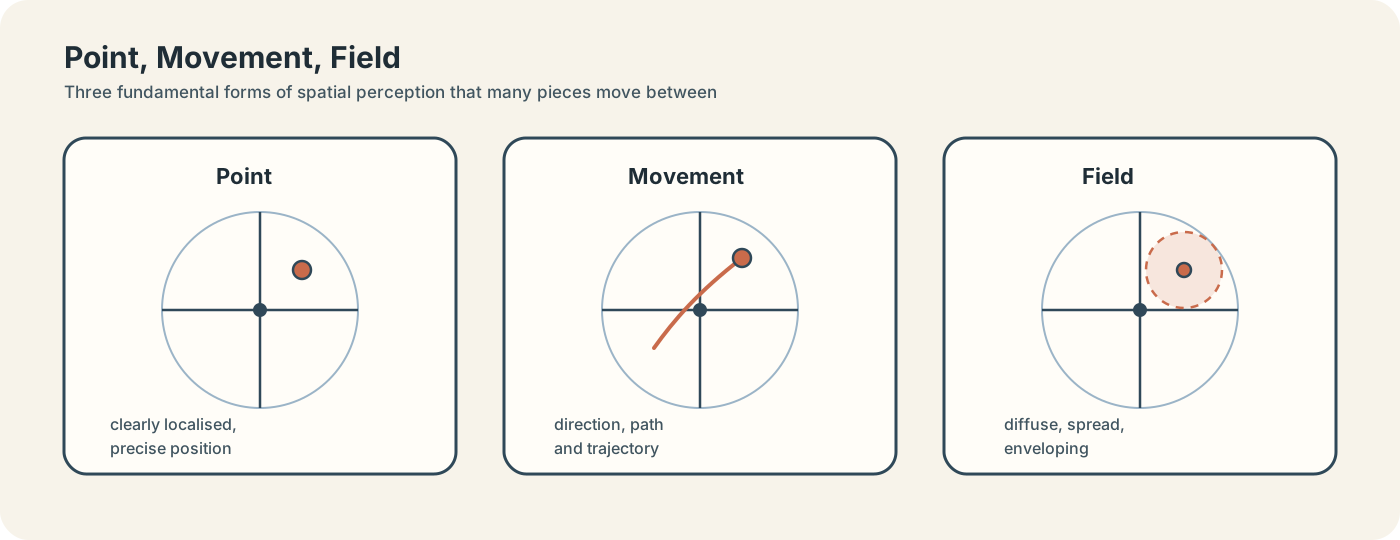
The fundamental distinction is: Am I hearing a sound as a point, as a movement, or as a field?
Envelopment refers to the feeling of being surrounded by sound — sound reaching the listener from all directions simultaneously, with no clearly localisable source, producing a diffuse spatial impression. The tension between precise localisation and spatial envelopment is one of the most important characteristics of spatial music.
In the three-dimensional sound field, it is not only what you hear that changes, but how you hear. Your body becomes part of the analytical system. (Heijden et al., 2018)
Preparing for a listening session
Enter the room a few minutes before the first sonic event, find your listening position, and let the silence work on you. This brief settling-in supports conscious awareness of the space before the piece begins — including its reverberation, size, and ambient noise floor.
Before listening, form concrete questions to direct your attention. For example:
- Where in the piece do precise localisations appear, and where does the sound spread into spatial fields?
- What role does movement play in the form?
- Does my impression change when I move my head slightly?
This way you enter the listening session actively, with a specific question already in mind.
Before listening, note down:
- Where am I sitting in the room?
- How does the room sound without music?
- What one or two questions am I bringing into this session?
Three levels of active listening
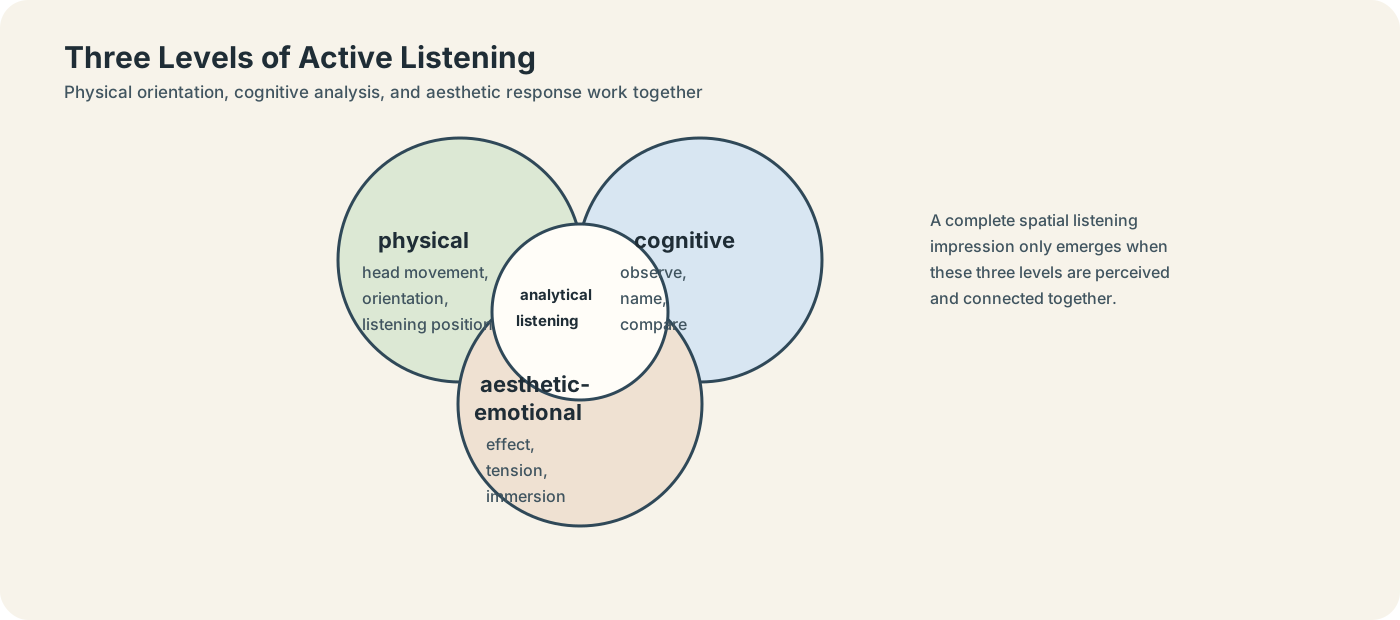
In the three-dimensional sound field you experience music on three levels simultaneously: physical, cognitive, and aesthetic-emotional. These levels complement one another. A complete listening impression typically only emerges when all three are working together.
1. Physical level: movement as a listening technique
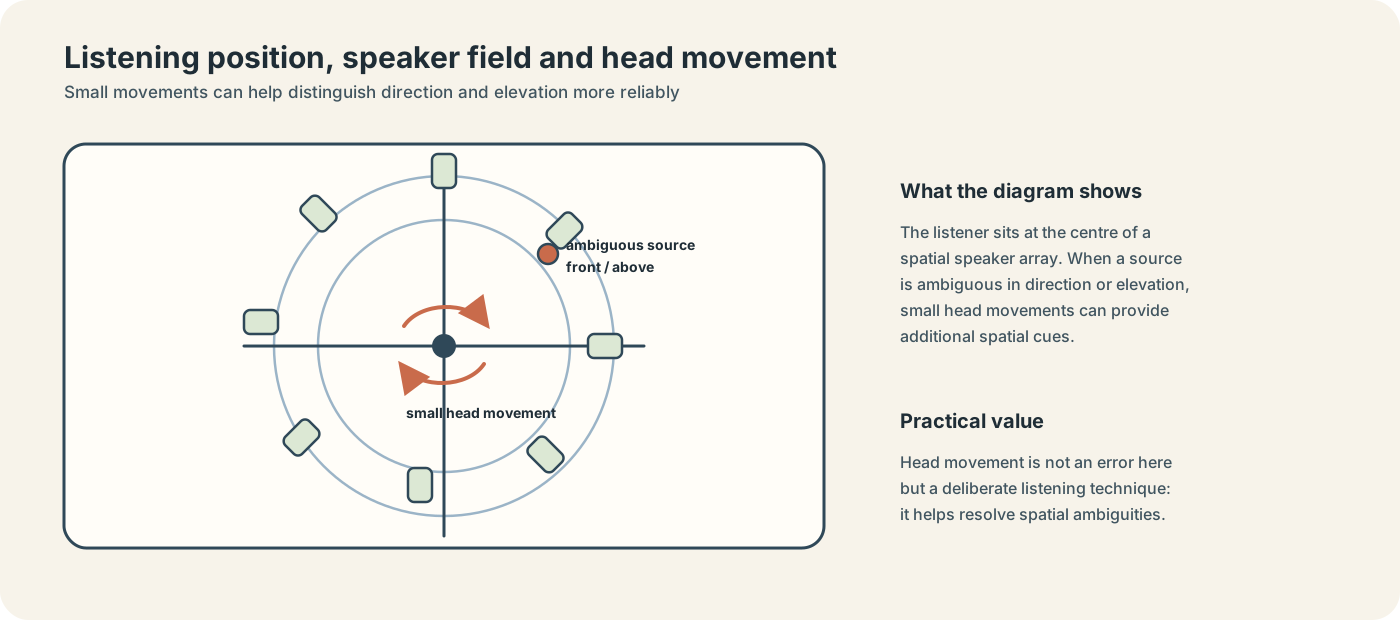
Spatial listening is not entirely static. Psychoacoustic research shows that small, natural head movements can improve the localisation of sound sources. (Heijden et al., 2018; Xie & Yu, 2021) The reason is that spatial cues shift subtly during movement: inter-aural time differences, level differences, and spectral colouration are all reweighted.
In the ICST studio with its 17 Geithain loudspeakers — designed for spatial reproduction — there is no need to sit motionless in the sweet spot. The sweet spot is the optimal listening position from which the spatial properties of the speaker system are most precisely perceived. Small, deliberate movements can be part of the listening act.
These techniques transfer to other systems too — setups with fewer speakers, or headphone listening. With stereo loudspeakers, slight head movements also help sharpen localisation cues and distinguish between sound sources. With headphones, spatial impression is often artificially generated, but conscious attention to direction, distance, and envelopment remains productive. Most of the observation questions and listening techniques in this guide support active, analytical listening regardless of the system being used.
Practical techniques
- Rotate your head slightly left or right when you cannot localise a source.
- Tilt your head gently forward or back to get a better sense of the elevation plane.
- To assess envelopment, listen first toward the front, then deliberately into the rear of the space.
Limits of this technique
With very short, fast, or transient events, movement can impair perception — the brain often has no time to integrate new spatial information. In these situations, quiet, concentrated stillness is the better strategy. Knowing when movement helps and when stillness is preferable is itself part of active listening.
2. Cognitive level: observe, name, compare
The second level involves conscious observation.
The following grid helps you track the essential spatial parameters systematically:
| Parameter | Observation question | Possible values |
|---|---|---|
| Azimuth / direction | Where does the sound come from horizontally? | left, right, front, rear |
| Elevation | Is the sound at ear height, above, or below? | low, ear level, high, ceiling |
| Distance | How near or far does the source sound? | very close, medium, far, distant |
| Spread / diffusion | Is the sound point-like or broadly distributed? | point, wide, diffuse, field |
| Movement | Does the source move, and if so, how? | static, rotation, linear, implosion |
| Layering | How many spatial layers are active simultaneously? | one, two, several, overlapping |
| Envelopment | Am I surrounded by sound, or am I hearing it from outside? | none, slight, clear, complete |
Three spaces after Smalley
Denis Smalley’s concept of space-form (1997, 2007) offers one of the most useful analytical frameworks for spatial electroacoustic music. He distinguishes three overlapping categories of spatial experience:
Perspectival space is the listener’s sense of position within a real or imagined acoustic environment — distance, room size, the impression of listening from a specific vantage point. In an Ambisonics piece, this may shift abruptly: you are suddenly inside a resonant cathedral, then in an anechoic chamber, then in open air. Listening task: map the imagined room. Does it change? When?
Source-bonded space describes space that clings to recognisable sound objects — the physical distance and position associated with a footstep, a voice, an instrument. When a source-bonded sound moves in the Ambisonics field, the movement is perceptible not just as a position change but as a narrative event: it approached, it circled, it receded. Listening task: follow one source-bonded object from entry to exit.
Spectral space is space that emerges from spectral and textural structure rather than from localisation — the sense that high frequencies occupy the upper hemisphere while low frequencies surround the floor, or that brightness and density are distributed directionally. This category is the least immediately obvious but often the most compositionally significant. Listening task: on a second pass, close your eyes and try to sense the spectral geography of the piece — where does the high material live? Where does the dense material concentrate?
For a compositional perspective on the same methodology — including detailed case studies and psychoacoustic analysis — see the Blog for forthcoming work analyses.
Five analytical questions
Bring these five questions to each piece. You do not need to answer all of them in one listening — pick one or two per work.
1. How is the space organised? Is the spatial field symmetrical or asymmetrical? Does the composer use the full sphere or concentrate on the horizontal plane? Is above/below treated as compositionally equivalent to front/back?
2. What moves and what stays still? Movement and stasis are a basic spatial opposition, equivalent to tension and release in tonal music. A fixed, central low drone against moving high-frequency trajectories is already a spatial form. Can you identify the moving layer, the static layer, and the relationship between them?
3. How is envelopment used? Envelopment — the sense of being surrounded rather than positioned in front of a source — is one of the most powerful affordances of a full-sphere system. Does the piece use it as a constant condition or as an event? Is there a moment where the field collapses from envelopment to a single localised point, or vice versa?
4. Is there depth stratification? Does the piece create a sense of near and far, or does everything occupy the same perceived distance? Layered distances — a close foreground against a diffuse far background — create a spatial depth analogous to perspective in visual composition.
5. Does space carry semantic weight? This is the most interpretive question: does the spatial organisation mean something in the context of the piece? In Natasha Barrett’s work (#10 ascolta, March 2024), spatial movement is part of a compositional argument about inside and outside, containment and release. In the acousmatic tradition, this relates to Schaeffer’s écoute réduite (reduced listening) — except here the reduction is spatial: try listening only to the spatial behaviour, bracketing timbral and pitch content entirely.
3. Aesthetic-emotional level: taking effect seriously
Alongside the physical and cognitive dimensions there is a third, equally significant level: the aesthetic-emotional. Spatial music can produce immediate responses — spaciousness, restlessness, pressure, stillness, shelter, or immersion.
These responses are not a disturbance to analysis but part of the material. What matters is describing them as precisely as possible. Rather than simply noting “threatening”, ask: what produces this effect?
- Does it come from direction, elevation, distance, or movement?
- Does the sound remain outside my body, or does it seem to enclose me?
A close, rearward sound can feel oppressive because it receives no frontal resolution. A diffuse, high-register sound can produce spaciousness or detachment, because it cannot be fixed as a single point. In this way, a subjective response becomes an analytically usable observation.
Integration: how the three levels work together
Active listening requires not treating these three levels in isolation, but connecting them.
You turn your head slightly and thereby localise a source obliquely to the rear right (physical). This gives rise to a question: as the distance increases, does the timbre also change (cognitive)? At the same time you notice that the rearward position produces a slight unease (aesthetic-emotional).
Here is where real analysis begins: from perception, a question emerges about form, effect, and possible compositional intention.
Listening in two passes
For many pieces, it is helpful to listen twice with deliberately different attention.
First pass
- orient yourself in the space
- register prominent movements and zones
- attend to spontaneous physical and emotional responses
Second pass
- work more deliberately with observation questions
- compare localisation, distance, layering, and envelopment
- examine how spatial means contribute to formal structure
The first pass serves spatial orientation; the second supports conceptual sharpening and analysis.
Listening in two passes
Pass 1
- What stands out immediately?
- Where is movement, elevation, or envelopment most pronounced?
- What spontaneous effect arises?
Pass 2
- Which parameters can be named more precisely?
- How does space relate to form?
- Which moments do I want to hear again?
Format comparison (for sessions where the same piece appears in different formats)
When a piece is presented in stereo and in Ambisonics, or in surround and in HOA, use this note structure:
| Dimension | Stereo / Surround | Ambisonics |
|---|---|---|
| Localisation precision | ||
| Sense of depth | ||
| Envelopment | ||
| Source movement | ||
| Most surprising difference |
Filling in the table during or immediately after each version prevents the second version from overwriting the memory of the first.
Recording your observations
Spatial impressions are fleeting. Note down as directly as possible after a listening session:
- Which spatial zones were active, and when?
- Were there moments of particular tension, density, or resolution?
- What physical responses did you notice?
- What emotional quality was perceptible, and what produced it?
- What questions remain open for a second pass?
A brief, precise note immediately after listening is generally more valuable than a later reconstruction from memory.
Example of a precise note
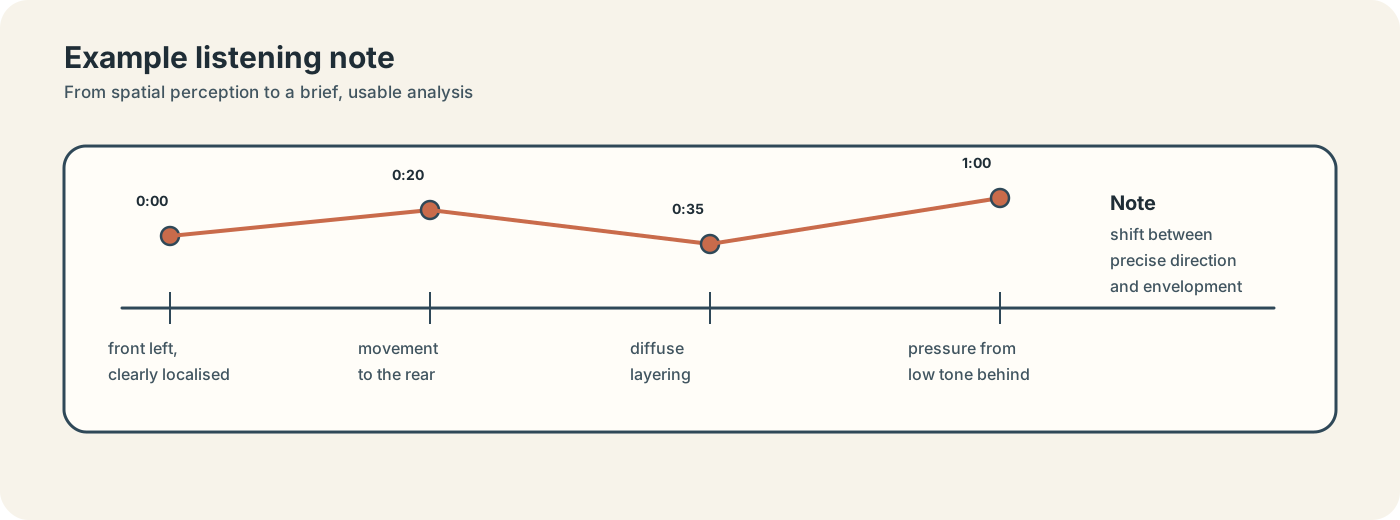
At the opening, a strongly localised sound front left — short movement to the rear, then diffuse layering there. Sudden pressure as a low tone enters behind me; I notice tension in the back of my neck. After about a minute the space opens; the sound feels brighter and less dense. The overall alternation between precise direction and envelopment is striking.
Further theoretical context
If you want to deepen these observations theoretically, two approaches are particularly useful.
Pierre Schaeffer’s concept of écoute réduite (reduced listening) describes a mode of hearing that examines sounds independently of their cause or source — attending to the acoustic object itself. This orientation is also productive for spatial analysis.
Denis Smalley develops in Space-form and the acousmatic image (2007) categories such as perspectival space, source-bonded space, and spectral space — concepts that map directly onto the observation grid described above. His earlier Spectromorphology (1997) describes how spectral features and their changes over time combine into shapes, from which spatial categories emerge.
After a session, compare your map or notes with another listener. You will almost always find that you attended to different spatial moments — this is compositionally intentional in a full-sphere system, where no two seats receive identical inter-aural information. The divergence in observation is itself evidence of the spatial complexity of the work.
References
Psychoacoustics and perception
Heijden, K. v., Rauschecker, J. P. & Formisano, E. (2018). Active Sound Localization Sharpens Spatial Tuning in Human Primary Auditory Cortex. The Journal of Neuroscience, 38(40). https://doi.org/10.1523/JNEUROSCI.0587-18.2018
Xie, B. & Yu, G. (2021). Psychoacoustic Principle, Methods, and Problems with Perceived Distance Control in Spatial Audio. Applied Sciences, 11(23). https://doi.org/10.3390/app112311242
Ziemer, T. (2023). Psychoacoustic Sound Field Synthesis for Music. Springer. https://link.springer.com/book/10.1007/978-3-031-26863-2
Gaveau, V., Parizet, E., & Koehl, V. (2022). Perceptual evaluation of high-order ambisonics reproduction. Acta Acustica, 6, 28.
Theory of listening and space-form
Schaeffer, P. (1966). Traité des objets musicaux. Paris: Éditions du Seuil.
Smalley, D. (1997). Spectromorphology: Explaining sound-shapes. Organised Sound, 2(2), 107–126.
Smalley, D. (2007). Space-form and the acousmatic image. Organised Sound, 12(1), 35–58.
Barrett, N. (2019). Spatial music composition. In: Dean, R. (ed.), Oxford Handbook of Computer Music. Oxford University Press.
Organised Sound thematic issue on spatial audio composition (2025), Cambridge University Press.
Practice and studio context
Schuett, J. (2021). ICST Kompositionsstudio. https://icst-kompositionsstudio.ch/post/icst-kompositionsstudio
Girot, C., Schütz, N., Toro-Pérez, G., Schütt, J., Feucht, F. & Vollmer, M. (2012). Raum-Klang-Labor. ETH Zürich. https://girot.arch.ethz.ch/archived/raum-klang-labor