#08 Ascolta Acousmatic Listening Session
Audience: Composer, Student, Researcher, Studio visitor.
Tuesday, October 24, 2023, 18:00
- Toni-Areal,
- ICST-Kompositionsstudio (3.D02, Ebene 3)
- Pfingstweidstrasse 96,
- 8005 Zürich
Free admission
La Canción de la Tierra
Mesias Maiguashca Artist in Residency at ICST: 2018 | February 28 – March 1, 2019 | April 25 – April 26, 2019 | 2020
La Canción de la Tierra (an audiovisual composition 2017-2020)
Idea and music: Mesias Maiguashca, Video: Carlos Poete. Audio-Ambisonics technique: Johannes Schütt.
This work is today played as ‘Cinema pour l’oreille’ without the video!
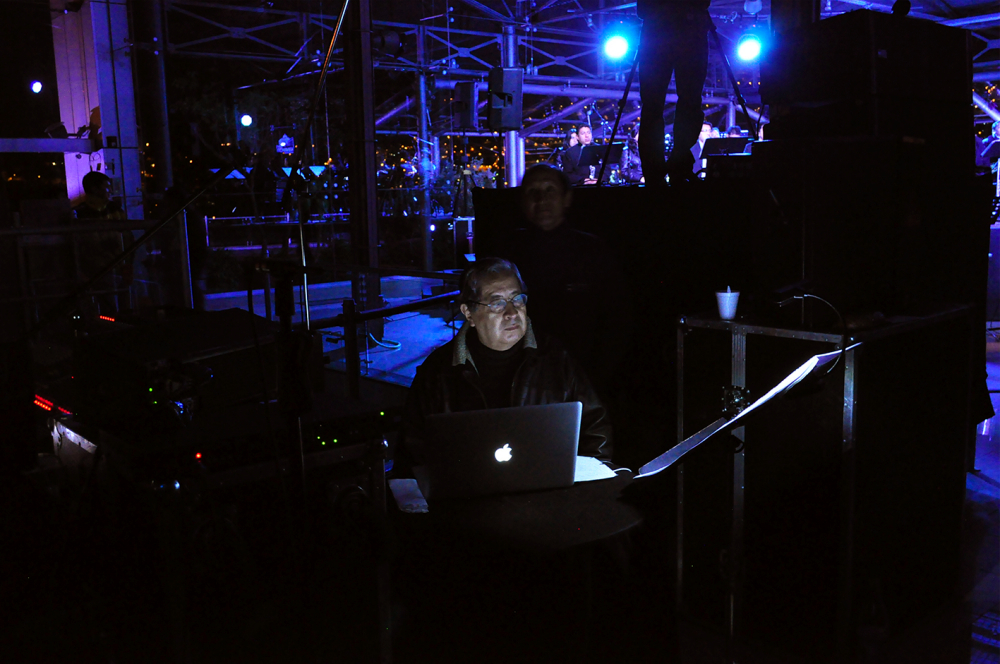 Mesias Maiguashca
Born in Quito, Ecuador, the 24th of December, 1938, Mesías Maiguashca studied at the Conservatorio de Quito, the Eastman School of Music (Rochester, N.Y.), the Instituto di Tella (Buenos Aires) and at the Musikhochschule in Cologne. He realized compositions in the Studio for Electronic Music WDR (Cologne), the Centre Européen pour la Recherche Musicale (Metz), IRCAM (Paris), Acroe (Grenoble) and ZKM (Karlsruhe), and teached in Metz, Stuttgart, Karlsruhe, Basel, Sofía, Quito, Cuenca, Buenos Aires, Bogotá, Madrid, Barcelona, Györ y Szombathely (Hungary), Seoul (Corea) and his works were presented at the most important European festivals.Maiguashcas was professor for electronic music at the Musikhochschule Freiburg from 1990 until his retirement in 2004. Together with Roland Breitenfeld, he founded the K.O.Studio Freiburg in 1998, a private initiative for the practice of experimental music. He lives in Freiburg since 1996.
www.maiguashca.de
Mesias Maiguashca
Born in Quito, Ecuador, the 24th of December, 1938, Mesías Maiguashca studied at the Conservatorio de Quito, the Eastman School of Music (Rochester, N.Y.), the Instituto di Tella (Buenos Aires) and at the Musikhochschule in Cologne. He realized compositions in the Studio for Electronic Music WDR (Cologne), the Centre Européen pour la Recherche Musicale (Metz), IRCAM (Paris), Acroe (Grenoble) and ZKM (Karlsruhe), and teached in Metz, Stuttgart, Karlsruhe, Basel, Sofía, Quito, Cuenca, Buenos Aires, Bogotá, Madrid, Barcelona, Györ y Szombathely (Hungary), Seoul (Corea) and his works were presented at the most important European festivals.Maiguashcas was professor for electronic music at the Musikhochschule Freiburg from 1990 until his retirement in 2004. Together with Roland Breitenfeld, he founded the K.O.Studio Freiburg in 1998, a private initiative for the practice of experimental music. He lives in Freiburg since 1996.
www.maiguashca.de
The first time I heard Das Lied von der Erde by Gustav Mahler (roughly 30 years ago, as a student, already in Europe), I decided to also compose a Song of the Earth, una Canción de La Tierra. Of course, my composition should sound different. We know that our history, American history, does not begin with the “discovery” and conquest by Europeans. We know well that the overlay of European culture upon American culture brought it to the brink of destruction and disappearance. European philosophy, religion, and ways of life became the norm of American life, and in many respects they still are. But I think that a specific Andean way of comprehending the world exists. I certainly cannot describe it, let alone explain it. Can one make it sound?
The composition La Canción de la Tierra, for an ensemble of Andean instruments, for a wind ensemble, a choir of 6 women and 6 men, as well as two groups of “sound objects” made of wood and metal, which I myself designed, was premiered in 2013 in Quito. Unfortunately, the concert could not be satisfactorily documented due to the technical and musical complexity. For this reason, I have designed the audiovisual composition described here as a remembrance. It is not a documentation of the concert; it is an autonomous work. The sound track is largely based on the original recording of the concert. The audio version with Ambisonics technology was realized in the studio of ICST /ZHdK (Zurich University of the Arts), sound engineer Johannes Schütt.
La Canción de la Tierra consists of 14 canciones: Canción del ser, canción del ruido cósmico, canción del hanan-pacha, canción de la papa, canción del agua, canción del granizo, canción de la brisa, canción del estar, canción del kay-pacha, canción de los guacamayos, canción del uku-pacha canción del paisaje seco, canción de la cordillera, canción del amanecer.
La Canción de la Tierra is a meditation and a song of homage and gratitude to Nature, to Mother Earth, to the Pachamama.
Quoted from the website of Mesias Maiguashca (2022)