New here? Start with Ambisonics in REAPER
Level: Beginner to Advanced | Audience: Composers, students, producers, technicians, and studio residents.
Ambisonics is a method for capturing and reproducing three-dimensional sound. The ICST plugins bring this approach into REAPER through free, open-source, studio-tested workflows developed at ZHdK Zurich.
If you are new, follow the guided start path. If you already know the plugins, jump straight to Quick Start, tutorials, or the docs.
New in v3.2: What’s New · GitHub Releases
🎛️ Working with Ambisonics?
Free and open-source spatial audio tools for REAPER — from first setup to advanced OSC control and DAW integration.
Guided 4-step start path🎧 For Beginners
Fast entry into setup, signal flow, and your first spatial mix in REAPER.
⚙️ For Production Work
Technical depth for repeatable pipelines, OSC control, and robust session templates.
🎼 Composing in Ambisonics
Spatial thinking for composers — analytical listening, movement and depth as compositional parameters, studio workflows. Composing Guide coming soon.
🎛️ Ambisonics Plugins for REAPER
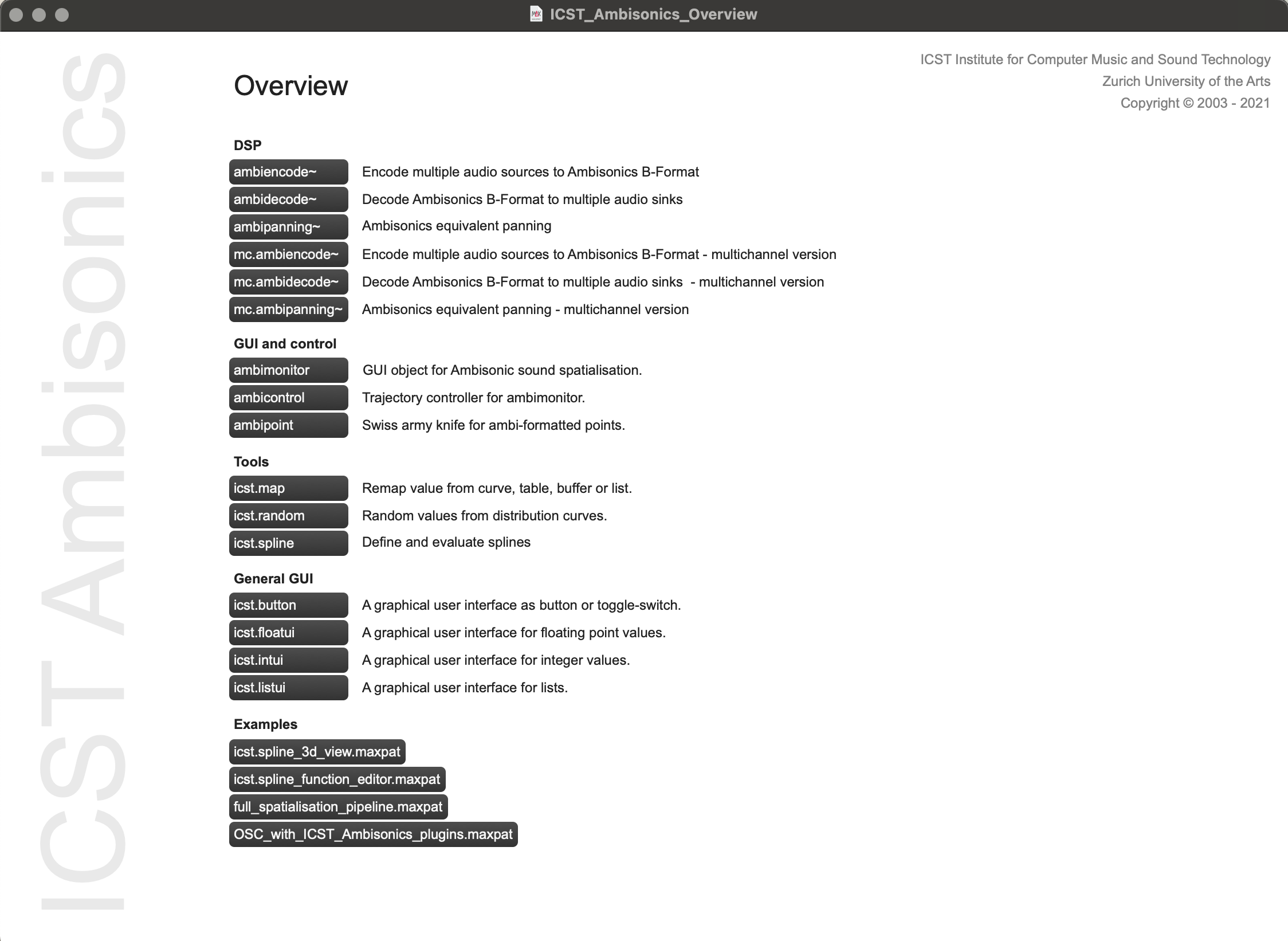
Encode, decode, and spatialise audio directly in your DAW. Encoder, decoder, monitor, and more — the complete ICST suite.
🧊 Ambisonics Tools for Max/MSP
For live spatialisation, algorithmic sound, and extending workflows beyond REAPER — runs natively in Max 8.
🏛️ At the ICST Studio?
For ZHdK residents, composers and studio visitors — listening sessions, residency documentation and studio resources.
Resident guide — 4 steps before & during your stay🎧 ASCOLTA
Regular acousmatic listening sessions and concerts at ZHdK — spatial works performed live, open for audience.
🎼 Residencies
Artist-in-residence programme at ICST — profiles, projects and documentation from past and current residents.
🖥️ Composer Studio
Setup documentation, equipment, speaker configurations, and studio cases from the ICST Composition Studio.
Latest Posts
BLAUERT'S BANDS
Level: Advanced | Audience: Psychoacoustics-focused composer/researcher.
BLAUERT'S BANDS
Level: Advanced | Audience: Psychoacoustics-focused composer/researcher.
#10 ASCOLTA ACOUSMATIC LISTENING SESSION
Audience: Composer, Student, Researcher, Studio visitor. The Composer, Herself Concert March 19, 2024, 18:00 Toni-Areal, Kompositionsstudio 3.D02, Ebene 3, Pfingstweidstrasse 96, Zürich Free admission Program: Natasha Barrett Prince Prospero’s Party [2005] 2nd order Ambisonics 16:00 One of the first pieces in Ambisonic second order was by Natasha Barrett as Artist in Residency 2005 at the HMT Zurich. Natasha Barrett (1972) is a composer who explores new technologies and experimental approaches to sound in contemporary music, including concert works, public space sound-art installations, and multimedia interactive music. She is internationally renowned for her electroacoustic and acousmatic music and use of 3D sound technology in composition. Her work is commissioned and performed throughout the world and has received over 20 international awards, including the Nordic Council Music Prize, the Giga-Hertz Award (Germany), five first prizes, and the Euphonie D’Or in the Bourges International Electroacoustic Music Awards (France), two first prizes in the International Rostrum for electroacoustic music and most recently the Thomas Seelig Fixed Media Award for 2023. She collaborates with performers, visual artists, architects, and scientists and is active in performance, education, and research. Link: http://www.natashabarrett.org/about.html
ICST AMBIDECODER – MULTI-DECODER MODE
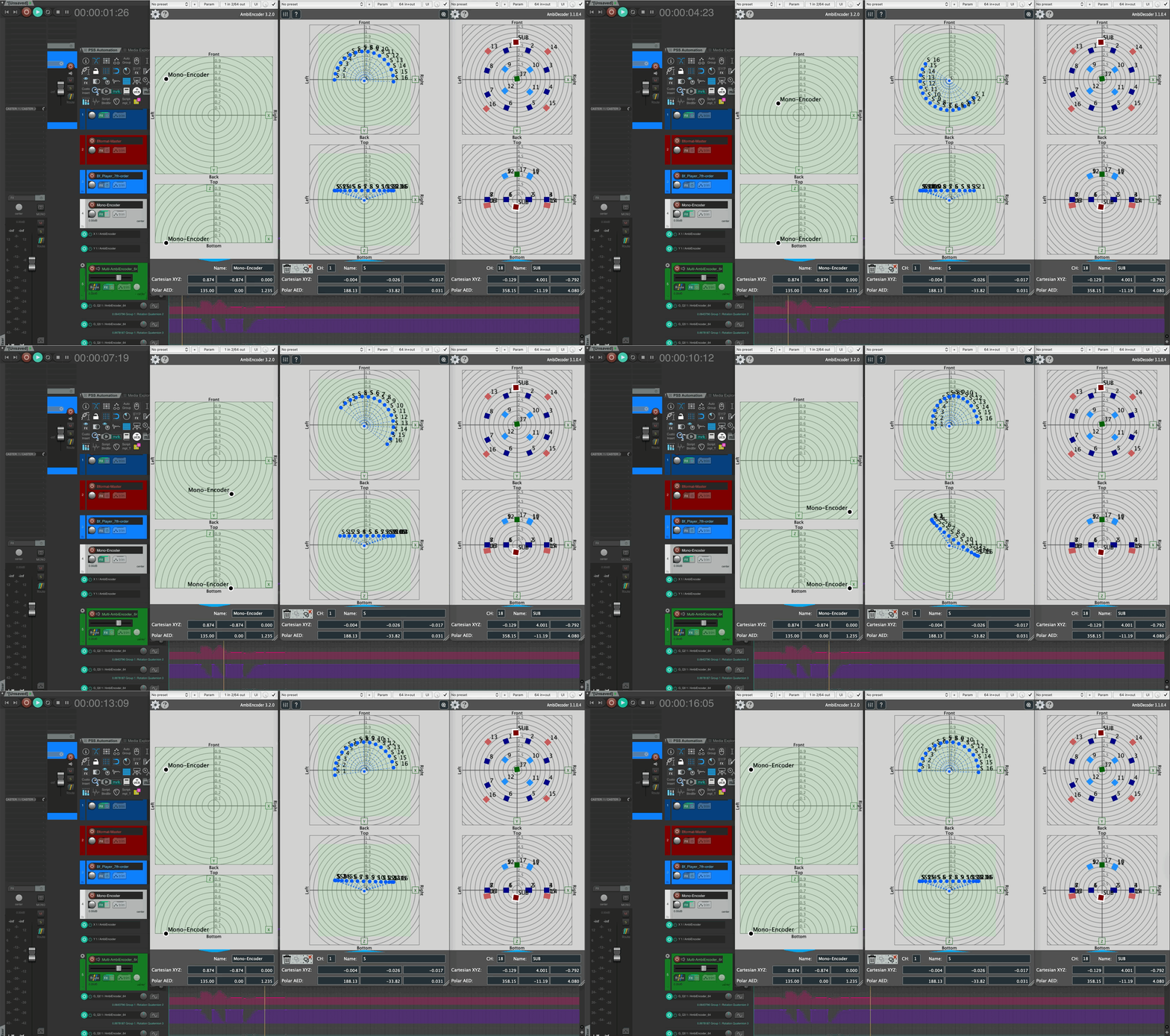
Multi-Decoder Mode Level: Advanced | Audience: Technician, Studio engineer. The Multi-Decoder Mode, introduced in ICST AmbiDecoder v3.2, allows you to run up to four fully independent decoders within a single plugin instance. This is ideal for complex loudspeaker setups that combine different speaker arrays — for example, a main Ambisonics ring together with height speakers, a subwoofer group, or a separate near-field array. When to use Multi-Decoder Mode Use Multi-Decoder Mode when your setup includes:
ICST COMPOSITION STUDIO SPEAKER SETTINGS
Level: Beginner | Audience: Composer, student, researcher, studio visitor. Preset views and reference layouts for fast setup in the ICST studio. Common Presets Use stereo, surround, and Ambisonics layouts as quick starting points. Stereo Dolby Ambisonics Routing Flexibility Switch between predefined layouts or use all speakers for custom routing. Quadro All Speakers Downloads Stereo Yellow = RL911 Gray = MO-2 Red = MO-2 (Behind the screen) Dolby Surround 5.1 Surround 7.1.4 Atmos Octagon & Ambisonics Ring 1-8 (clockwise) & Ambisonics (2D) Ambisonics Full (17 speakers) Quadrophonic Quadro (diagonal) Quadro (orthogonal) All speakers Create your own speaker routings Further Links Speaker Files & Downloads Regie Equipment Software Legacy Speaker Settings
#11 ASCOLTA ACOUSMATIC LISTENING SESSION
Audience: Composer, Student, Researcher, Studio visitor. Mario Mary, portrait Concert 11.06.2024, 18:00 Toni-Areal, Kompositionsstudio 3.D02, Ebene 3, Pfingstweidstrasse 96, Zürich Free admission Programm: 2015 Polyphonic philosophy pièce électroacoustique en 8 pistes. [ 10’ 43’’] Commande de l’ICST de Zurich, Suisse. Création à l’Université de Zurich en novembre 2015 Continuing the aesthetic exploration about “electroacoustic orchestration” and “polyphony of space” of the previous works “Signes émergents” and “2261”, the first section of this composition develops in the horizontal plane a concept that could be called “melody of sound objects”. Here, polyphony and counterpoint of the musical discourse is interwoven through with small sound objects, creating polyphony and counterpoint taking advantage of the possibilities offered by the multitracks space with 8 tracks around public.
ICST COMPOSITION STUDIO PHOTO GALLERY
Level: Beginner | Audience: Composer, student, researcher, studio visitor. The ICST Composition Studio
#12 ASCOLTA ACOUSMATIC LISTENING SESSION
Audience: Composer, Student, Researcher, Studio visitor. Georg Katzer Concert 22.10.2024, 18:00 Toni-Areal, Kompositionsstudio 3.D02, Ebene 3, Pfingstweidstrasse 96, Zürich Free admission Programm: Steinelied 2 2010 10' Notes: Steinelied 2 In a cloud chamber, ionising radiation leaves a condensation trail with tiny water droplets, thus making the particle ‘visible’. Likewise, the ‘stones’, namely the silicon crystals of the computer, leave small ‘droplet-shaped’ sound events as they rush through the time-tone space in the computer I programmed. Between the mostly impulsive sounds, a short tonal structure emerges several times, as if from a distance, perforated by the impulsive sounds. It is reminiscent of a scent ‘from distant planets’, that of a bygone tonal music. In any case, it was just as welcome to me as the sometimes ‘dirty sounds’, which I did not try to embellish. And everything is shrouded in a ‘blue fog’. The piece is not composed with a climax in mind; rather, it remains static, revolving around itself, almost meditative.
#13 ASCOLTA ACOUSMATIC LISTENING SESSION
Audience: Composer, Student, Researcher, Studio visitor. Listening twice Experimental 17.12.2024 18:00 Toni-Areal Kompositionsstudio 3.D02, Ebene 3, Pfingstweidstrasse 96, Zürich Free admission The title of this audio lesson is Listening Twice. Based on the empirical research ‘Performance and storage of multi-channel content in an immersive audio format,’ I would like to design a slightly different listening session. Listening twice means listening to a 2-channel piece in its original form and then interpreting it in a new immersive format. These two audio formats can thus be compared and discussed. So, this is a somewhat experimental listening session at the end of the year.
EXPLORE AMBISONICS AUDIO
Listen Online Audience: Composer, Student, Researcher, Studio visitor. sounding FUTURE HOAST Library Nimbus UHJ ICST B-Format Archive The ICST maintains an archive of works recorded and encoded in ambiX B-format. → Explore the B-Format Archive