New here? Start with Ambisonics in REAPER
Level: Beginner to Advanced | Audience: Composers, students, producers, technicians, and studio residents.
Ambisonics is a method for capturing and reproducing three-dimensional sound. The ICST plugins bring this approach into REAPER through free, open-source, studio-tested workflows developed at ZHdK Zurich.
If you are new, follow the guided start path. If you already know the plugins, jump straight to Quick Start, tutorials, or the docs.
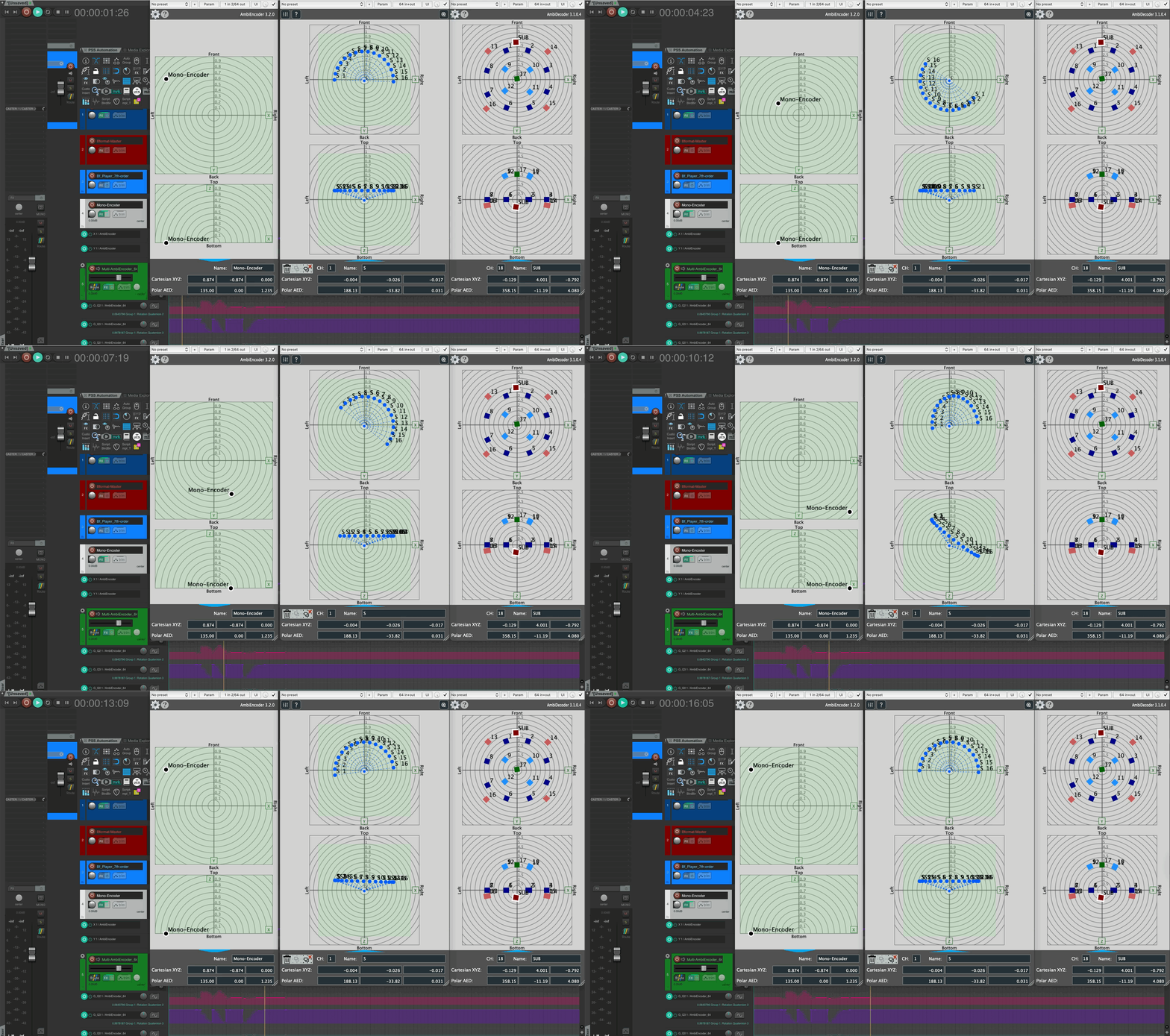
New in v3.2: What’s New · GitHub Releases
🎛️ Working with Ambisonics?
Free and open-source spatial audio tools for REAPER — from first setup to advanced OSC control and DAW integration.
Guided 4-step start path🎧 For Beginners
Fast entry into setup, signal flow, and your first spatial mix in REAPER.
⚙️ For Production Work
Technical depth for repeatable pipelines, OSC control, and robust session templates.
🎼 Composing in Ambisonics
Spatial thinking for composers — analytical listening, movement and depth as compositional parameters, studio workflows. Composing Guide coming soon.
🎛️ Ambisonics Plugins for REAPER
Encode, decode, and spatialise audio directly in your DAW. Encoder, decoder, monitor, and more — the complete ICST suite.
🧊 Ambisonics Tools for Max/MSP
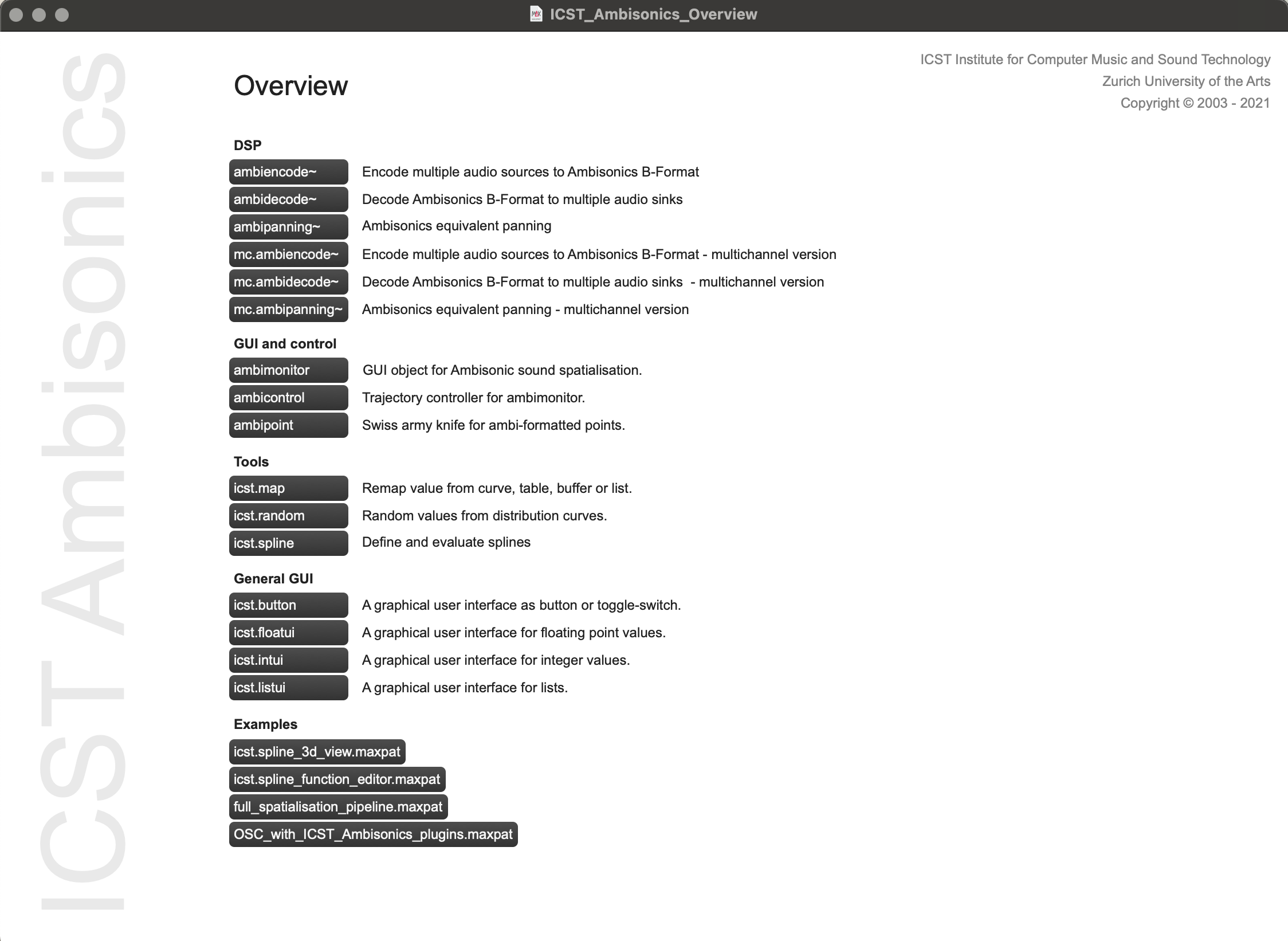
For live spatialisation, algorithmic sound, and extending workflows beyond REAPER — runs natively in Max 8.
🏛️ At the ICST Studio?
For ZHdK residents, composers and studio visitors — listening sessions, residency documentation and studio resources.
Resident guide — 4 steps before & during your stay🎧 ASCOLTA
Regular acousmatic listening sessions and concerts at ZHdK — spatial works performed live, open for audience.
🎼 Residencies
Artist-in-residence programme at ICST — profiles, projects and documentation from past and current residents.
🖥️ Composer Studio
Setup documentation, equipment, speaker configurations, and studio cases from the ICST Composition Studio.
Latest Posts
BINAURAL MONITORING IM ICST-WORKFLOW – KOPFHÖRER ALS KONTROLLWERKZEUG
Level: Intermediate | Audience: Komponist:in, Producer:in, Techniker:in. Binaural ist nicht nur ein Ausgabeformat. Wer eine Ambisonics-Produktion ohne Lautsprecher entwickelt – im Zug, im Homeoffice, an einem Laptop ohne Decodersystem – braucht eine zuverlässige Kopfhörer-Kontrolle, die das räumliche Feld möglichst unverfälscht wiedergibt. Dieser Artikel zeigt, wie du binaural in die ICST-Session integrierst, welche Plugins funktionieren und worauf du bei der Einrichtung achten musst. Warum Binaural-Monitoring kein Notbehelf ist Binaural aus HOA ist prinzipiell verlustärmer als Binaural aus FOA. Ein 3rd-Order-Signal trägt 16 Kanäle sphärischer Information; ein gut implementierter BinauralDecoder kann diese räumliche Auflösung vollständig für die Kopfhörer-Wiedergabe nutzen. Das Ergebnis ist einem ersten Ordnung deutlich überlegen: schärfere Lokalisation, überzeugendere Elevationsabbildung, breiterer Sweetspot.
DEN B-FORMAT-MASTER EXPORTIEREN – AMBIX, KANALREIHENFOLGE UND NORMALISIERUNG
Level: Intermediate | Audience: Komponist:in, Techniker:in, Toningenieur:in. Eine fertige Ambisonics-Produktion zu exportieren klingt trivial – ist es aber nicht. Ein falsch konfigurierter Render erzeugt stille Kanäle, vertauschte Kanalreihenfolge oder falsch normalisierte Signale, die in der nächsten Produktionsstufe falsch klingen, ohne dass ein offensichtlicher Fehler sichtbar ist. Dieser Artikel zeigt, wie du einen korrekten AmbiX-Master aus REAPER heraus erzeugst. Das Format: AmbiX Der heutige Industriestandard für Ambisonics-Austausch ist AmbiX. AmbiX definiert zwei Dinge:
AMBISONICS-MIKROFON AUFNEHMEN – A-FORMAT, B-FORMAT UND DIE ICST-INTEGRATION
Level: Intermediate | Audience: Komponist:in, Sounddesigner:in, Recording-Techniker:in. Ambisonics-Mikrofone nehmen den Raum auf – nicht als Stereo, nicht als Surround, sondern als vollständiges sphärisches Schallfeld. Das klingt nach mehr als es zunächst ist: Fast alle käuflichen Ambisonics-Mikrofone sind First-Order-Geräte (FOA). Sie liefern vier Kanäle, die das Feld in einer Auflösung beschreiben, die für Raumatmosphären, Texturen und Klangobjekte hervorragend ist, für die scharfe Lokalisation eines HOA3- oder HOA7-Systems aber nicht ausreicht. Dieser Artikel erklärt den Aufnahmeprozess, die Konvertierung und wie das Ergebnis in den ICST-Workflow integriert wird.
WELCHE AMBISONICS-ORDNUNG BRAUCHE ICH? – HOA-WAHL IN DER PRAXIS
Level: Beginner–Intermediate | Audience: Komponist:in, Producer:in, alle die eine neue Ambisonics-Session aufsetzen. Die Wahl der Ambisonics-Ordnung ist eine der ersten Entscheidungen jeder Produktion – und sie bestimmt Kanalzahl, CPU-Last, Plugin-Anforderungen und die klangliche Qualität auf einem Lautsprecher-System. Dieser Artikel erklärt die Zusammenhänge ohne Mathematik und gibt klare Empfehlungen für typische Situationen. Die Grundformel Die Anzahl der Kanäle im B-Format-Master ergibt sich aus der gewählten Ordnung: (N + 1)² = Kanalzahl
SZENEN-ROTATION – DAS GESAMTE B-FORMAT-FELD DREHEN
Level: Intermediate | Audience: Komponist:in, Live-Techniker:in, Recording-Techniker:in. Ambisonics hat gegenüber kanalbasierten Formaten einen entscheidenden Vorteil: Das B-Format-Feld ist rotationsinvariant. Eine gespeicherte Ambisonics-Szene lässt sich jederzeit nachträglich drehen – ohne Qualitätsverlust, ohne neue Encoder-Durchläufe, ohne die Quellen einzeln anzufassen. Dieser Artikel zeigt, wie diese Rotation in der Praxis funktioniert. Szenen-Rotation vs. Objekt-Rotation Es gibt zwei grundlegend verschiedene Arten, räumliche Positionen in Ambisonics zu bewegen: Objekt-Rotation (ICST AmbiEncoder / AmbiAnimator): Einzelne Quellen werden an andere Positionen bewegt. Azimut, Elevation und Distanz einer Quelle ändern sich. Alle anderen Quellen bleiben wo sie sind.
KOMPOSITION IN AMBISONICS: RAUM, BEWEGUNG UND PERFORMANCE
Am besten bereitest du dich auf Ambisonics wie auf ein eigenes Instrument vor: nicht nur „mehr Raum", sondern ein kompositorisches System mit Perspektive, Bewegung, Dichte und Übersetzung in verschiedene Wiedergabesituationen. Das bedeutet: Raum ist kein Effekt, den man am Ende auf eine fertige Komposition legt. Er ist ein Parameter, der von Anfang an mitgedacht werden muss — genauso wie Timbre, Dynamik oder Form. Wer Ambisonics erst im Mix „aufträgt", nutzt das System nur zur Hälfte.
GESCHICHTE UND ANWENDUNGEN DES AMBISONICS DECODERS
Thema: Vom Theoriemodell zum Werkzeug – wie der Ambisonics Decoder entstand und wozu er heute eingesetzt wird. Zeitraum: 1970er bis heute Relevanz für: Komponist:innen, Techniker:innen, Forschende im Bereich räumlicher Audioproduktion Kernaussagen Der Ambisonics Decoder ist nicht ein Produkt, sondern ein Konzept – seine Geschichte ist die Geschichte wachsender Anforderungen an räumliche Auflösung. Die entscheidende Weiterentwicklung kam nicht durch neue Hardware, sondern durch präzisere psychoakustische Kriterien und höhere mathematische Ordnungen. Heutige Decoder wie der ICST AmbiDecoder sind direkte Nachfolger eines über 50 Jahre alten Paradigmas – mit denselben Grundprinzipien und radikal erweiterten Möglichkeiten. 1. Die Ursprünge: Gerzon und das Decodierungsproblem (1970er) Als Michael Gerzon und Peter Fellgett Anfang der 1970er die Grundlagen von Ambisonics entwickelten, war das zentrale Problem nicht die Aufnahme, sondern die Wiedergabe. Das B-Format beschreibt ein Schallfeld – aber wie bringt man dieses Feld auf eine konkrete Anordnung von Lautsprechern?
THE HISTORY OF AMBISONICS: FOA AND HOA AS A VISUAL TIMELINE
This timeline separates the development of FOA and HOA while also showing their shared milestones. The picture that emerges: FOA is the historical foundation of Ambisonics; HOA arrives later as a systematic extension for higher spatial resolution. FOA line HOA line Shared standards and media practice flowchart TB classDef foa fill:#d9f3f4,stroke:#00838f,color:#0d2a2d,stroke-width:1.6px; classDef hoa fill:#ffe7d1,stroke:#ef6c00,color:#432100,stroke-width:1.6px; classDef shared fill:#eceff1,stroke:#455a64,color:#1f2a30,stroke-width:1.4px; A["1970sGerzon and Fellgett develop the foundations of Ambisonics"]:::shared subgraph FOA["FOA: First-Order Ambisonics"] direction TB F1["1973Periphony: With-Height Sound Reproduction"]:::foa F2["1975The term Ambisonics becomes established"]:::foa F3["Late 1970sUHJ makes Ambisonics stereo-compatible"]:::foa F4["1980sFOA enters practical use in recording, broadcasting, and UHJ releases"]:::foa F5["1990sFOA remains the dominant practical form and teaching basis"]:::foa F6["2010s–presentFOA remains the accessible entry point for 360 audio and production"]:::foa end subgraph HOA["HOA: Higher-Order Ambisonics"] direction TB H1["2000/2001Jérôme Daniel establishes the modern theoretical basis for HOA"]:::hoa H2["2003Near-field and distance coding extend HOA"]:::hoa H3["2005Poletti grounds HOA in spherical harmonics"]:::hoa H4["2006–2009Microphone arrays, symposia, and research make HOA practical"]:::hoa H5["2011ambiX unifies channel ordering and normalisation"]:::hoa H6["2010s–presentHOA becomes a key technology for VR, XR, and scene-based audio"]:::hoa end S1["2011File and interchange formats become critical for HOA workflows"]:::shared S2["2018RFC 8486 standardises Ambisonics in Ogg Opus"]:::shared S3["TodayFOA and HOA coexist as practical and scalable formats"]:::shared A --> F1 --> F2 --> F3 --> F4 --> F5 --> F6 A --> H1 --> H2 --> H3 --> H4 --> H5 --> H6 F5 --> S1 --> S2 --> S3 H4 --> S1 FOA FOA is the historical core of Ambisonics. It is compact, robust, and still the stronger choice wherever straightforward production, distribution, and compatibility matter more than maximum directional resolution.
ICST B-FORMAT ARCHIVE
A curated collection of Ambisonics B-Format reference files for testing decoders, binaural renderers, and spatial audio pipelines. All files use the ambiX convention: ACN channel ordering, SN3D normalisation. If you need the format background first, read Ambisonics Formats Explained for A-Format vs B-Format, FuMa vs ambiX, FOA/HOA, ACN/SN3D, and channel counts. Audio Files Search Order All5th order Sort by Title Order Channels SR Bits Direction Ascending Descending Composer Title Duration Format Order Normalisation Channels SR Bits Listen Download AudioBrewers AmbiTest_ambix_5th-order.wav 4′ WAV 5th order ACN/SN3D 36 48000 24 Binaural ↗ — No entries found for the current filter.
DOWNLOADS
All ICST tools and supporting files in one place. Plugins Studio Files PDF Guides B-Format Papers 🎛️ ICST Ambisonics Plugins for REAPER Free and open-source VST3/AU/LV2 plugin suite for Higher Order Ambisonics in REAPER — encoder, decoder, multi-decoder, monitor, and animator. 🎛️ Plugin Download Current macOS and Windows installers on GitHub. Requires REAPER 6+. Download from GitHub → Plugin Docs Installation Guide 🧊 Max/MSP Externals ICST Ambisonics Tools for Max 8 — live spatialisation, algorithmic sound, and OSC integration. Hosted on ZHdK.